SECTION 1: INTRODUCTION TO THE TRANSIT PREMIUM CONCEPT
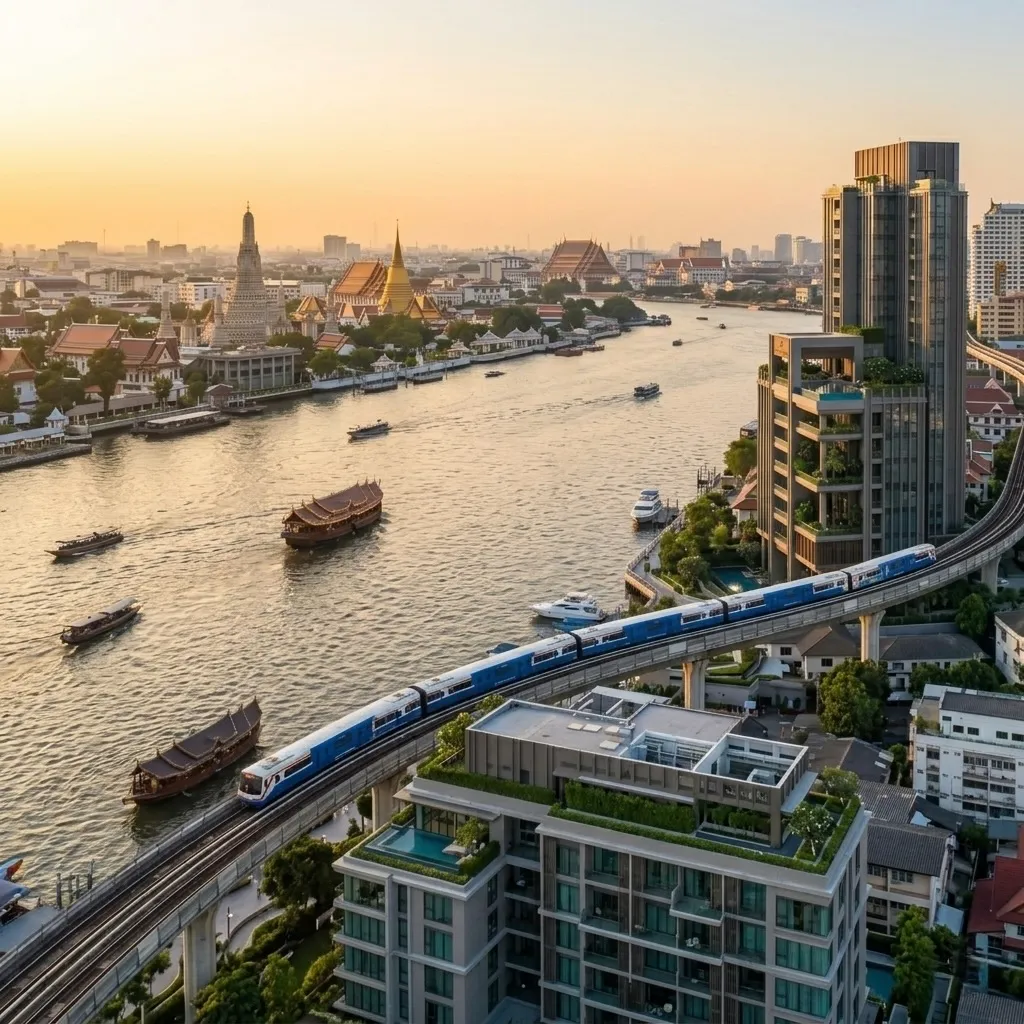
In a mega-city like Bangkok, traffic congestion is not merely an inconvenience; it is a structural economic variable that directly shapes property valuations. The capital growth and rental liquidity of urban condominiums in Bangkok are tethered to the city’s mass transit rail infrastructure—specifically the BTS Skytrain and MRT Subway networks. This phenomenon is known among institutional real estate analysts as the "Transit Premium." As the rail network expands into secondary and tertiary outer rings, the real estate market is bifurcating into hyper-connected transit hubs and stagnant off-rail zones. For the foreign investor, understanding the exact spatial relationship between a condominium's front gate and the nearest mass transit station is the single most critical factor in mitigating risk and maximizing internal rate of return (IRR).
SECTION 2: THE ANATOMY OF THE RATION ZONE – 0 TO 500 METERS
The investment viability of a metropolitan condominium drop-offs exponentially the further it is located from a transit station. Real estate appreciation metrics confirm that properties fall into three distinct zones based on pedestrian proximity.
Pedestrian Proximity Metric Table
Proximity Zone | Distance to Station | Capital Growth Potential | Rental Liquidity Index | Target Tenant Profile |
Tier 1: Core Transit | 0 – 200 Meters | Extremely High (8%–11% YoY) | Exceptional (Under 14 days vacant) | High-earning expats, corporate executives |
Tier 2: Premium Walk | 201 – 500 Meters | High (5%–7% YoY) | Stable (14–30 days vacant) | Japanese/Western expats, local professionals |
Tier 3: Secondary Radius | 501 – 1,000 Meters | Moderate (2%–4% YoY) | Seasonal; relies heavily on shuttle vans | Budget-conscious expats, digital nomads |
SECTION 3: MAPPING THE HIGH-YIELD CORRIDORS
When analyzing the Bangkok mass transit map, investors must differentiate between established legacy lines and high-growth expansion corridors.
[LEGACY GREEN LINE] ---> Sukhumvit Core (Asok / Phrom Phong / Thong Lo) ---> Premium Yields / Low Risk
[EXPANDING BLUE LINE] --> Urban Ring (Rama 9 / Ratchada / Asoke-Phetchaburi) -> High Growth / Emerging Hubs
[NEW ORANGE LINE] ----> East-West Arterial (Ramkhamhaeng / Min Buri) ---------> Speculative / Long-Term Value
1. The Legacy Green Line (Sukhumvit Core)
The BTS Green Line remains the economic spine of Bangkok. The segment stretching from Ploenchit and Chidlom through Asok, Phrom Phong, Thong Lo, and Ekkamai represents the highest land values in the Kingdom.
Investment Verdict: Low risk, premium pricing. Properties here consistently command the highest rental rates because the international corporate expat community refuses to live off this line.
2. The MRT Blue Line (The Urban Loop)
The MRT Blue Line acts as Bangkok’s only orbital loop, connecting major commercial centers with historical and residential quarters. The Rama 9 - Ratchadaphisek stretch has evolved into the "New CBD," attracting multinational Chinese, Korean, and Japanese enterprises.
Investment Verdict: Balanced risk-reward. Capital entry barriers are lower than the Sukhumvit Core, while rental demand from regional white-collar professionals remains structurally high.
SECTION 4: THE 49% FOREIGN QUOTA & LEGAL REQUISITES
Foreign investors must navigate the specific legal frameworks governing Thai real estate. Under the Thai Condominium Act, foreigners are permitted to hold absolute freehold ownership of up to 49% of the total saleable area of a condominium building. This is known as the "Foreign Quota."
Critical Compliance Checklist for Foreign Buyers:
The FET Form Requirement: Every single Dollar, Euro, Won, or Yen used to purchase the condominium must enter Thailand as foreign currency and be converted to Thai Baht by a local receiving bank. The bank issues a Foreign Exchange Transaction (FET) certificate. Without this exact document, the Land Department will refuse to register the transfer of ownership to a foreigner.
The Premium on Foreign Quota Units: In highly desirable transit-adjacent buildings, the 49% foreign quota often sells out completely during off-plan stages. Consequently, units within the foreign quota can command a secondary market resale premium of 5% to 15% over the exact same layout within the Thai quota.
SECTION 5: PROPERTY MANAGEMENT AND TAXATION STRUCTURING
To secure the transit premium, a hands-off investor must deploy professional property management structures. High-end property management firms handle tenant sourcing, credit screening, background checks, and automated maintenance protocols.
Investor Taxation Architecture
Withholding Rental Income Tax: Foreigners residing outside of Thailand are subject to a flat 15% withholding tax on rental income collected from Thai properties, which can often be optimized under double taxation avoidance agreements (DTAA) depending on the country of origin.
Land and Building Tax: Instituted to replace the old rental tax, this progressive tax is calculated based on the government-appraised value of the property rather than actual rental yields. For standard residential condos, the rates are exceptionally low (typically under 0.02%–0.1%), preserving the investor's net margins.
SECTION 6: FUTURE PROJECTIONS FOR THE BANGKOK TRANSIT SECTOR
The mass transit expansion plan continues to decentralized Bangkok’s urban density. By connecting outer industrial and suburban sectors directly into the central corporate grid via interchanging super-stations like Bang Sue Grand Station (Krung Thep Aphiwat Central Terminal), the capital appreciation landscape is shifting. Savvy investors are tracking where these transit networks intersect. Stations serving as multi-line transfer points (e.g., Asok/Sukhumvit, Silom/Sala Daeng, and emerging junctions along the Orange and Yellow lines) represent the ultimate defensive real estate play for the next decade.